• DSC_0032

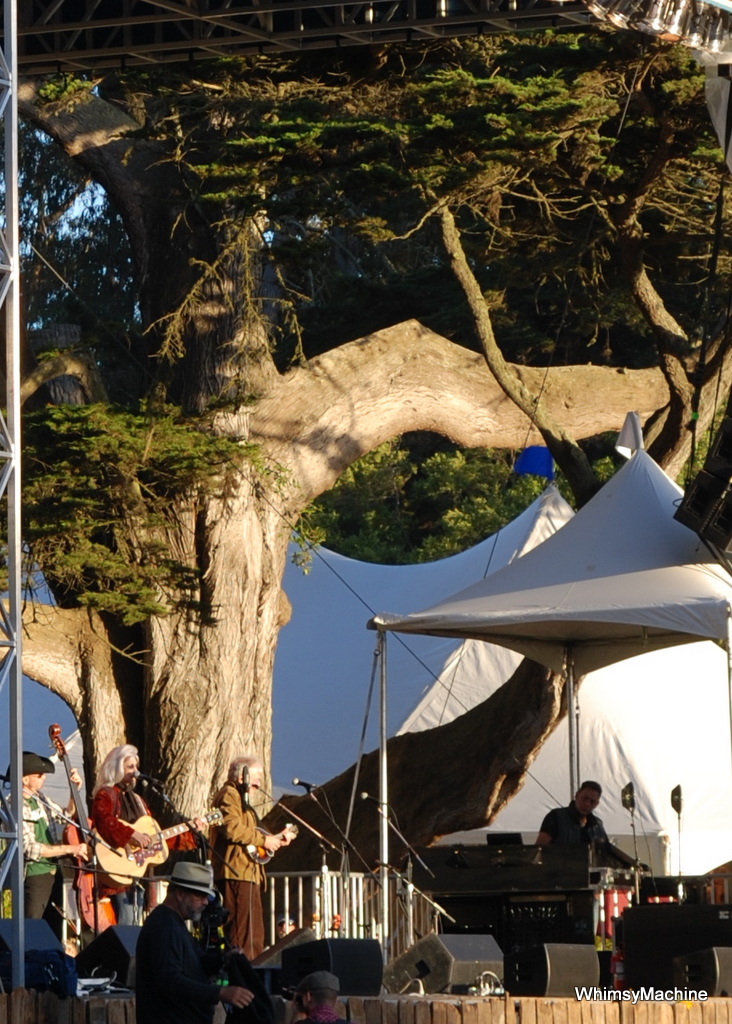
    Last big festival of the season (and a good one its been).  This weekend (Oct. 2/3/4) is the HardlyStrictlyBluegrass Festival in Golden Gate Park.  A huge lineup of artists and somewhere between 100,000 and 500,000 people are expected to show up for this free festival sponsored by one man as a gift to the music he loves.  Warren Hellman (of Hellman & Friedman who recently raised a 8+ billion dollar private equity fund).  Bless the man…this gift brings a lot of joy to the area and is now one of the largest music festivals in the country.

    That and its fall season – cool crisp breeze…sunshine with the few clouds and listening to Steve Earle, EmmyLou Harris, Earl Scruggs and some wonderful old-timey bands (Roan Mountain Hilltoppers last time) some new discoveries (Chris Smithers) in that setting…bliss. 

    This year, I'm hoping to catch John Prine, Guy Clark, Old Crow Medicine Show, The Abalone Dots and Doc Watson among others and if Emmy Lou Harris closes out with John the Baptist, I'll be just as riveted and rocked as I was last year.

    DSC_0035

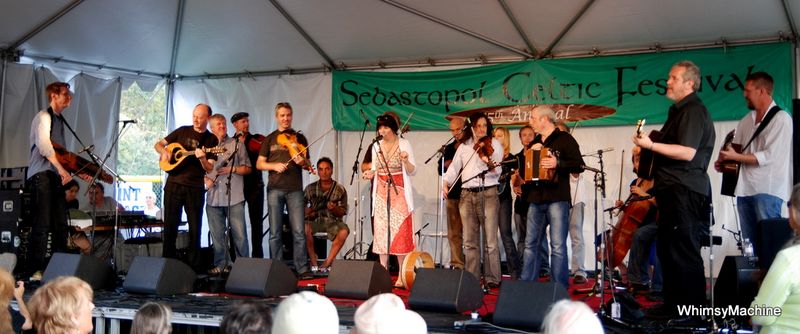
  • Amazing three days at the Celtic & World Music Festival in Sebastopol and a day tramping around the coast in Point Reyes.  Some festival photos are now up on my Flickr stream.

    Heard many wonderful new (to me) artists – Moira Smiley, Joe Craven and many old favorites – Cathy Jordan's (Dervish) high and clear voice carried a few beautiful ballads that will live long in memory.  Moira Smiley's vocal riffs and Joe Craven's improvisations were joyful to watch and hear.  Liam Kelly's flute, Tom Morrow's fiddle (Dervish) were perfection & passion combined.  Martin Hayes and Dennis Cahill continue to enthrall.  Aaron Jones & Jonny Hardie's (Old Blind Dogs) harmonies are amazing and the Dogs had David Brewer helping them fill out for their piper who had an emergency – their sets were as good as I remember.

    CelticFest09_0178

    I'll remember Dervish closing the Saturday night concert with Vasen with Josefina's Waltz and Slangpolska for a very long time – as rocking a close out as I've ever seen.  Many wonderful memories and some new friends.  I'll post some personal highlights eventually including discovering a Macedonian tune that captured my ears and heart.

    Search the web for any of these folks and you'll be rewarded with great music – go up to Sebastopol next year and support a GREAT festival.

  • SFMOMA (San Francisco Museum of Modern Art) hosts the Richard Avedon retrospective (jul-nov) and I haven't made it up there yet (sigh…). Hoping to see a few of my favorite portraits from this master of photography: his pictures of Ezra Pound (poet) & Isaiah Berlin (philosopher) from his Literature portfolio and Clarence Lippard (drifter) from the American West portfolio.  I remember being stunned at the life size enlargement of Clarence Lippard – the last time I saw the American West collection there – never looked at portraiture the same way again.  If you have the remotest interest in photography, go catch the show at sfmoma and grab lunch at the excellent cafe downstairs.

  • This is a story about a nearly 100-year-old book, bound in red leather, which has spent the last quarter century secreted away in a bank vault in Switzerland. The book is big and heavy and its spine is etched with gold letters that say “Liber Novus,” which is Latin for “New Book.” Its pages are made from thick cream-colored parchment and filled with paintings of otherworldly creatures and handwritten dialogues with gods and devils. If you didn’t know the book’s vintage, you might confuse it for a lost medieval tome.

    via www.nytimes.com

    Fascinating reading in the NYT Weekend Magazine on the pending publication of an essential part of Carl Jung's writings that have remained unpublished for years and are about to emerge from years of seclusion. The journal details a formative part of Jung's life when his mind teetered on the edge of reality.  Instead of retreating from the visions and hallucinations, he actively induced them and then documented his journey in meticulous detail in prose and art. 

    His writings and observations were the basis of his later work and the journal itself was both a resource and a work of art that he kept returning to for some 16 years.  The few illustrations and descriptions of the book make it seem more like a Carlos Casteneda (some of the indiscriminate reading from when I was 15 – amazing what
    you find as publisher's discards on the streets of Bombay – story for
    another day) book describing a shaman's journey  than dry analysis.  The illustrations themselves are the quality of what hangs in museums and reminiscent of some of Frida Kahlo or Salvador Dali – not necessarily pleasant but riveting.

    Reminded me to go back and put some of the books on Consciousness & Neurobiology (more my line of interest) back on the reading stack (Koch, Nooretranders for this winter).  Hope to find the "Red Book" at Kepler's to look through in December. 

  • Recently I read a novella that posed a really deep question: What would happen if physical property could be duplicated like an MP3 file? What if a poor society could prosper simply by making pirated copies of cars, clothes, or drugs that cure fatal illnesses?

    via www.wired.com

    Stumbled across this provocative article about why Science Fiction (as a writing genre) is the last bastion of philosophical writing (from Jan '08) while doing some catch up reading this Sunday and then coincidentally, TTBook (To The Best of Our Knowledge radio program) did a program with George R.R. Martin and Ursula K LeGuinn and S. Joshi – a biographer of H.P. Lovecraft broadcast on KQED/KALW and available at Ttbook.org that was just a joy to listen to on the evening walk.

    Whether you agree that Science Fiction is or is not the "last great literature of ideas", both the article and the radio program are worth your time if you are any kind of reader of any genre at all.  Lovely to hear these accomplished authors talk about the subject.  Here's an excerpt of the radio program – George R.R. Martin reading from his commentary in his book Dreamsongs (available as audio CD at Amazon) – as beautiful a paen to reading as I've ever seen:

    Why do I love fantasy?….[snipped]

    The best fantasy is written in the language of dreams. It is alive as dreams are alive, more real than real for a moment at least…that long magic moment before we wake. 

    Fantasy is silver and scarlet, indigo and azure, obsidian veined with gold and lapis lazuli.  Reality is plywood and plastic, done up in mud brown and olive drab.  Fantasy tastes of habaneros and honey, cinnamon and cloves, rare red meat and wines as  sweet as summer.  Reality is tofu and beans and ashes at the end. 

    Reality is the strip malls of Burbank and the smokestacks of Cleveland, a parking garage in Newark.  Fantasy is the Towers of Ministereth, the ancient stones of Gormenghast, the halls of Camelot.  Fantasy flies on the wings of Icarus, Reality on Southwest airlines.  Why do our dreams become so much smaller when they finally come true?  We read fantasy to find the colors again I think, to taste strong spices and hear the songs the sirens sang.  There is something old and true in fantasy that speaks to something deep within us, to the child who dreamt that one day, he would hunt the forests of the night, and feast beneath the follow hills, and find a love to lasts forever somewhere south of Oz and north of Shangri-La.  They can keep their heaven, when I die, I'd sooner go to Middle Earth.

    George R.R. Martin – Commentary exceprt from Dreamsongs

    Brought back memories of summer vacation reading binges, tearing through Jules Verne, Edgar Rice Burroughs, Herge (TinTin), even Enid Blyton (not quite fantasy but for a kid in India, tales of islands and camping, castles and kidnappers, boarding schools and bounders were near enough) – anything that would transport you away from the unbearable heat and restlessness of summer. 

    I'll omit LeGuinn's commentary and some of the writings of Lovecraft's philosophy  quoted by Joshi but they're well worth a listen at the  Ttbook.org  site.  I know that moving on from this world, instead of some pastel heaven, I might be just as happy on a balloon chase around the world with Passepartout in tow or rowing across to Kirrin Island to camp out for the night and watch for smugglers or battling robots with Magnus, the Robot-Fighter or from more recent reads – trying to lay low in Terry Pratchett's Ankh-Morpork with Lord Vetinari and the stalwart Sam Vimes to keep company.

  • Caught a gem on KQED/PBS tonight – http://bit.ly/2AQ8uF American Masters broadcast a profile of Dalton Trumbo, one of the Hollywood writers (Roman Holiday, Spartacus etc.) caught up in the blacklisting of suspected communist sympathizers. Go watch it today or buy the DVD when its released – best documentary I've seen in a while (released as a film a while ago).

    While I'd read about the witch hunt and the bravery of the men who were the Hollywood 10, this portrait brings home powerfully how one principled individual lived through that time.  His thoughts and reactions illustrated through readings of his letters by some great actors show a giant intellect and a complex human being who you could never have concocted in fiction.  His letters and writing say as much about persecution and the complicity of those who condone prosecutors and act on their behalf as the best theater or literature I've seen dealing with this human failing.  All that with determination, a sharp mind and a sense of humor shows a man who kept his dignity through some terrible times and lived a rich life.

    Beautifully produced, its based on a play by his son Christopher and on a book called "Additional Dialogue: Letters…" (available on Audible and on my list to download).  The clips and the previews really don't do the film justice – go see it soon.  Bravo to all those who supported and carried through this labor of love.

  • Pre-IFA 2009: Canon has announced a handful of compact cameras including models aimed squarely at keen photographers. Top of the line is the PowerShot G11, successor to its flagship PowerShot G10 compact released last year. The G11 replaces the G10's 14.7MP sensor with what it describes as a high sensitivity 10 MP CCD though it still uses the same 28-140mm equivalent stabilized lens. The camera also gains a tilt and swivel LCD, though the size drops to 2.8 inches. Flash sync speed increases to 1/2000th of a second and HDMI output is also added. Other features include Dual Anti-Noise System (more sensitive sensor and Digic 4 offering a claimed 2-stop improvement over the G10), RAW shooting and P/A/S/M shooting modes.

    via www.dpreview.com

    This one goes on my shopping list for this fall – might finally have the right low light performance and dynamic range.

  • For years now, the world’s camera companies have been taking the public for a ride. They’ve taught us to believe that what makes one camera better than another is the number of megapixels it has — when, in fact, the number of tiny colored dots making up a photo has very little to do with its color, clarity or even detail.

    via www.nytimes.com

    Very cool. Combine this with the news about the next Canon G11 actually shrinking the megapixels supported from 14 to 10 and it looks like finally, the megapixel marketing tide might be turning. We might someday be able to take good pictures indoors without flashes, blurs or bad grain. Now if they'd only add a really fast lens to these, we might get even more amazing pictures. Sigh…I miss my Canon A-1+50mm f1.2 lens.

  • The National Museum of Computing at Bletchley Park in the UK is seeking donors to help maintain and renew the site.  This site was the focal point of allied efforts to break the German Military Codes and is credited with shortening the war by two years by successfully cracking the codes and aiding in the D-Day invasion, among other military operations.  A large number of the brightest minds worked with the bleeding edge technologies of the day, the best known of whom was Alan Turing.  It is sometimes called "the birthplace of modern computing"

    My professional life owes a large debt to the seminal work in computing and cryptography that was done at this historical location.  The two major areas that I have spent my professional life in (Artificial Intelligence and Cryptography/Security) have a strong link to this place and to Turing in particular.

    Please consider a small donation in any amount you can afford to help this historically significant location and check out the site at:

    http://www.pgp.com/stationx/index.html


  • Spent a few days in San Francisco at TechCrunch50 churning the imagination a little.  The conference started out mixed on the first day but finished strong.  While it’ll take me another week or so to really digest and reflect on all the startups I saw and conversations I had, there were a few insights that stuck out a mile for me personally.  Here one on Devices and the Web

    •  I’ve been muttering about devices and their integration into the web for a few years now and still retain a subscription to "Embedded Systems" mostly to track how much easier and less capital-intensive it has become to put down a bet in this space.  I’ll even admit to having a Chumby 1.0 and few other net aware gadgets but one gadget at the conference took my fancy as a great example of how devices and sensors will enrich our world.
    • The company was called "Fitbit" and they have a well-designed personal activity monitor that can track physical activity and inactivity like a pedometeFitbit1Fitbit2_2r and sync wirelessly with its dock which will
      sync with Fitbit3a web site that allows you to track your activity and goals.  Its a brilliant concept given how much good intent can be reinforced with a little nudge.  Appropriately, the device doesn’t do a lot – no fancy heart monitor here – just a basic activity monitor.  Wise choice!
    • As a collector of modern automata and kinetic toys (and aspiring designer/maker), I’ve been eagerly awaiting more "off-the-shelf" parts to design/assemble amusements.  Utilitarian robots (e.g. Roomba) and cute dinosaurs are nice but sure would be nice to have more whimsy, connectivity and character in our devices and less of that "sync" business. There was a snippet in the commentary from the judges about the relative cost of prototyping devices like this coming down into the 150K range (less if you subscribe to Make Magazine and use the local TechShop.)